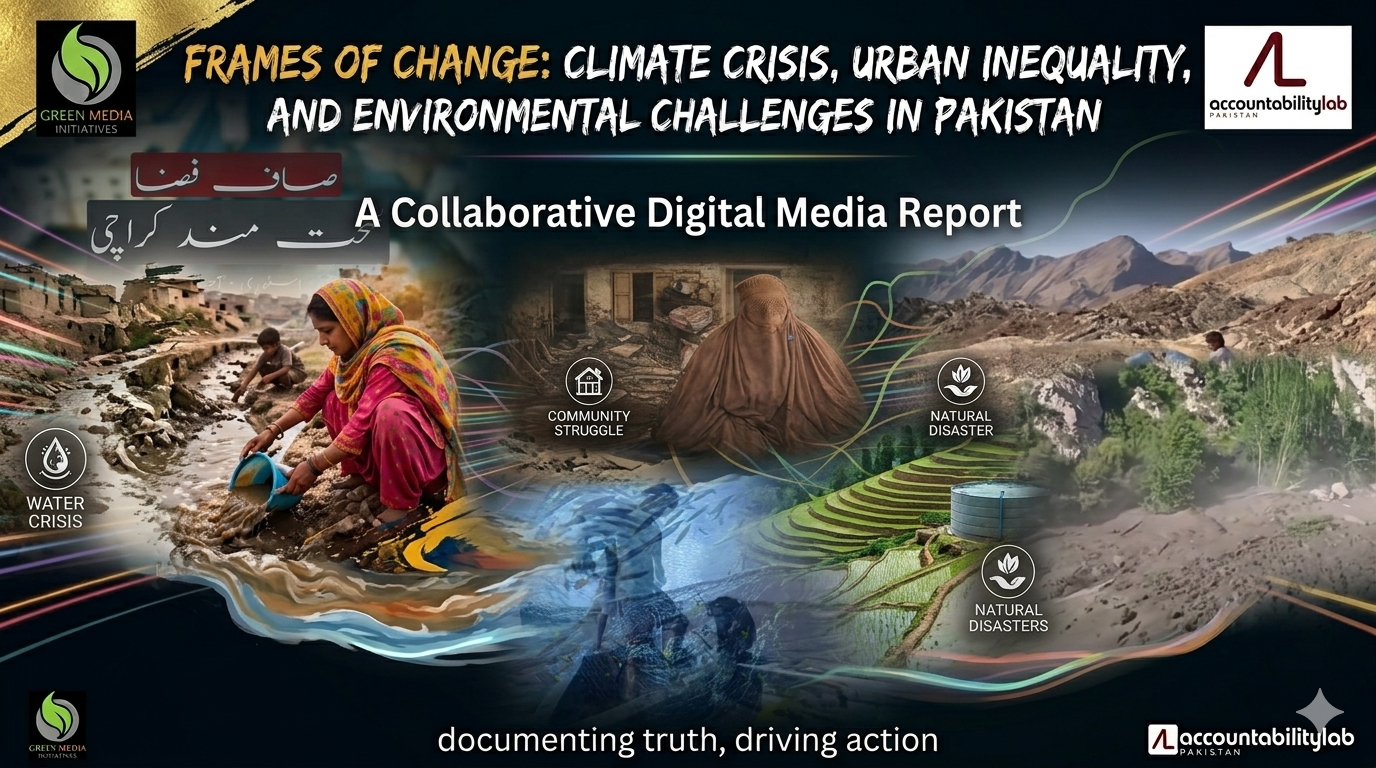

Pakistan is increasingly facing the devastating consequences of climate change, environmental degradation, and unequal urban development. From the flood-affected mountain regions of the north to the overcrowded informal settlements of Karachi and the drought-hit villages of Balochistan, vulnerable communities are struggling to survive amid worsening environmental conditions. A series of documentaries produced under Frames of Change by Accountability Lab Pakistan in collaboration with GMI – Gender Special highlights these realities and documents the human stories behind climate disasters and environmental neglect across the country.
Another major environmental concern highlighted in the documentaries is Karachi’s worsening air pollution and environmental degradation. As one of the world’s largest megacities with an estimated population of nearly 19 million people, Karachi faces severe challenges from traffic congestion, industrial emissions, unmanaged waste, and shrinking green spaces. According to the World Bank City Diagnostic report, green spaces in Karachi account for less than four percent of the city’s built-up area, far below international standards. The documentary by Asifa Idrees captures how pollution and environmental decline are becoming a normal part of everyday life for millions of residents. Research from the Air Quality Life Index suggests that Karachiites could increase their life expectancy by 2.7 years if air quality met World Health Organization standards. Although electric buses and modern transport systems are being introduced, experts believe deeper reforms in governance, infrastructure, and urban management are necessary to reverse the crisis.
Another documentary highlights the growing urban inequality crisis in Karachi, a city with a population of more than 21 million people according to the 2023 census. Nearly 75 percent of Karachi’s residents live in approximately 1,000 informal settlements, although only 565 are officially recognized. In many of these areas, untreated sewage fills the streets, making movement difficult and exposing residents to dangerous health risks such as dengue, malaria, and cholera. The documentary by Fouzia Jamil reveals how poor infrastructure, weak urban planning, and governance failures are forcing millions of people to live in unsafe and unhealthy conditions. It portrays the everyday struggle of marginalized communities who continue to suffer from neglect despite living in one of the country’s largest economic hubs.
Environmental challenges are not limited to land-based disasters. Karachi’s coastline is also facing serious ecological threats due to abandoned fishing gear known as ghost nets and ghost gear. These discarded nets continue trapping marine life long after being abandoned, damaging fragile ocean ecosystems and reducing fish populations. The documentary by Summaiya Khursheed Ahmed highlights how marine pollution is affecting both biodiversity and the livelihoods of coastal communities that depend on fishing for survival. The issue reflects the urgent need for responsible fishing practices, improved waste management, and stronger marine conservation policies to protect Pakistan’s coastal ecosystems.
One of the documentaries focuses on Tali Das, a village severely affected by the August 2025 floods caused by glacial lake outburst floods (GLOFs). The floods swept away more than 100 homes, destroyed farmland, and displaced entire communities. Families were forced to take shelter in temporary tents while struggling to rebuild their lives in extremely harsh conditions. Children in the village now walk long distances through difficult terrain to attend school, reflecting how disasters continue to disrupt education and daily life long after floodwaters recede. The documentary by Kiran Qasim captures not only the destruction but also the resilience of mountain communities facing increasing climate threats caused by glacier melting and rising temperatures in northern Pakistan.
In Gomazi, another environmental crisis is unfolding in the form of severe water scarcity. Following the devastating 2010 floods, the village has experienced prolonged drought-like conditions and limited access to clean water. Once home to around 50 families, only 13 households remain today as most residents migrated in search of better living conditions. Those who stayed behind rely heavily on children to fetch water from distant sources, often waiting for hours for their safe return. The documentary by Mahikan Rind illustrates how climate disasters can leave long-term consequences that continue for years after the initial event. The lack of water infrastructure and worsening environmental conditions have transformed everyday survival into a constant struggle for the remaining families.
The 2025 floods in Swat also demonstrate the growing impact of climate change on vulnerable regions. Once famous for its scenic beauty and tourism-driven economy, Swat suffered extensive destruction of homes, roads, businesses, and livelihoods during the floods. Many families lost their sources of income and continue to face difficulties rebuilding their lives. The documentary Drowned Dreams by Khalida Niaz documents the human and economic cost of the disaster while emphasizing the urgent need for climate resilience and sustainable recovery strategies. The floods exposed how dependent local economies are on stable environmental conditions and how quickly communities can fall into crisis when disasters strike.
Together, these documentaries reveal the interconnected nature of climate change, environmental degradation, poverty, and inequality in Pakistan. Whether in remote mountain villages, drought-hit rural communities, polluted coastlines, or overcrowded urban settlements, vulnerable populations are paying the highest price for environmental failures and climate-related disasters. The stories documented under Frames of Change emphasize that climate change is not only an environmental issue but also a humanitarian, economic, and social justice challenge. They call for urgent investment in climate adaptation, sustainable urban planning, environmental protection, disaster preparedness, and community resilience to ensure a safer and more sustainable future for Pakistan.